
Holehe vs Sherlock vs Maigret vs WhatsMyName: Which OSINT Tool Should You Use?
Compare Holehe, Sherlock, Maigret, and WhatsMyName: what identifier each one checks, how big their site lists are, how they decide a match exists, and which to reach for first.
These four names turn up together in almost every OSINT tool list, so it is natural to assume they compete head to head. They do not. Holehe, in its original form, checks email addresses. Sherlock, Maigret, and WhatsMyName check usernames. The question “which one is best” only makes sense once you know which identifier you are starting from, so that is where this comparison starts.
This guide lines up what each project actually does, how large their site lists are, how they decide a profile “exists”, and where their results agree or disagree. Rather than inventing a new benchmark, it draws on two tests already documented on this site: a live Holehe OSINT username search against three handles, and a side-by-side run of the original Holehe CLI against its web counterpart. Every figure below links back to its source in the Data Sources and Methodology section.
How this comparison was built. Site-list and detection-method figures for Sherlock, Maigret, and WhatsMyName come from each project’s public data file, downloaded October 23, 2026. Holehe OSINT username figures come from the same October 23, 2026 test session on this site’s homepage, searching the handlesmozilla,alex, and the random control stringqzv7k3xw9tlm. Original Holehe CLI and Holehe OSINT email figures come from a separate test on October 9 and 17, 2026, against[email protected], an address that belongs to this site. No private individual’s identifier was searched for this article.
Key Findings at a Glance
| Finding | Figure | Source |
|---|---|---|
| Holehe (original CLI) checks a different identifier than the other three | Email only, vs. username only for Sherlock, Maigret, WhatsMyName | Project documentation |
| Username site lists compared | Sherlock 481 · WhatsMyName 691 active · Maigret 7,516 active (8,215 listed) | Each project’s data file, Oct 23, 2026 |
| Sites Holehe OSINT’s web username search checks per run | 2,173 | Our test, Oct 23, 2026 |
| Email modules in the original Holehe README | 121, of which 31 flagged frequently rate-limited | megadose/holehe README, Oct 9, 2026 |
| WhatsMyName sites where HTTP status alone can’t separate found from not-found | 169 of 691 (24.5%) | WhatsMyName data file |
| Maigret active sites that need a text marker, not just a status code | 4,144 of 7,516 (55%) | Maigret data file |
| Sites reporting “found” for a made-up random string (the noise floor) | 267 of 2,173 (12.3%) | Our test, Holehe OSINT username search |
| Original Holehe CLI modules rate-limited in a single run | 77 of 121 (64%) | Our test, Oct 17, 2026 |
What Does Each Tool Actually Check?
This is the question that gets skipped in most “vs” articles. Get it wrong and you will run the wrong tool for the job.
| Tool | Identifier | Interface | Site / module count | Maintainer style |
|---|---|---|---|---|
| Holehe (original project) | Email address | Python CLI, pip install holehe or Docker | 121 modules (README) | Open source (GPL-3.0), last commit Sept 10, 2024 |
| Holehe OSINT (this site) | Email, username, phone, IP | Browser, no install | 111 email services · 2,173 username sites per search | Hosted web platform |
| Sherlock | Username | Python CLI | 481 sites | Open source, community maintained, last commit Sept 26, 2026 |
| Maigret | Username | Python CLI (Docker and a self-hosted web mode are also documented) | 7,516 active of 8,215 listed sites | Open source, community maintained, last commit Oct 22, 2026 |
| WhatsMyName | Username | Web app, plus a JSON dataset other tools reuse | 691 active sites | Open source, community maintained, last commit Oct 20, 2026 |
Sherlock, Maigret, and WhatsMyName are not three competing implementations of the same idea so much as three site-definition projects of different sizes and different detection rigor. Holehe (original or web) solves an adjacent but separate problem: it reads a site’s sign-up, login, or password-reset flow to decide whether an email address is already registered, which is a different signal from “does this username’s profile URL load”.
Site Coverage, Side by Side
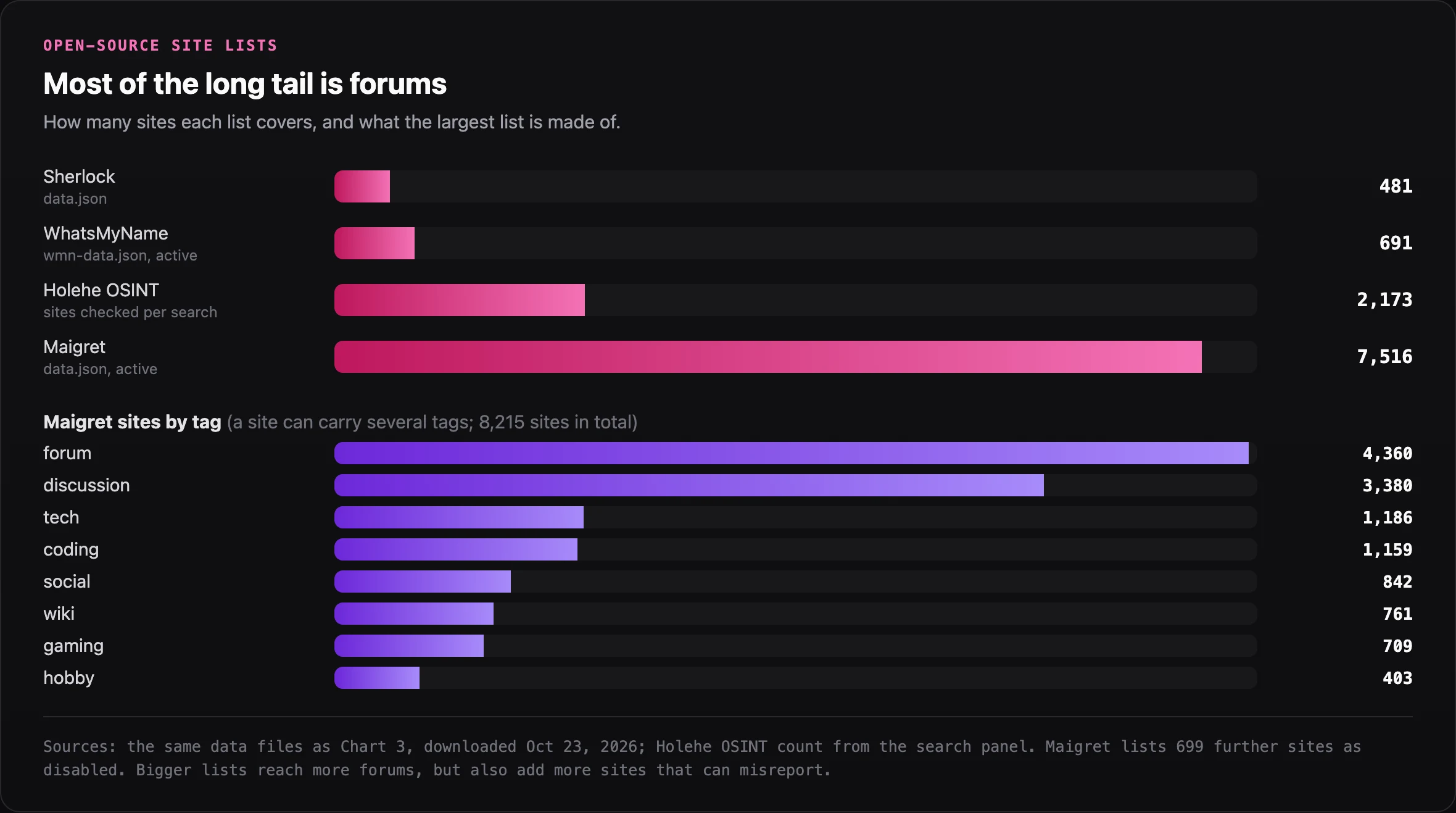
Bigger is not automatically better. Maigret’s list is more than ten times Sherlock’s because it reaches deep into forums and discussion boards (more than half of its tagged sites), which is exactly where people and companies leave details they would no longer publish themselves — but it is also exactly where site definitions go stale fastest. Sherlock’s smaller, curated list trades coverage for a shorter list to keep working. Holehe OSINT’s 2,173 sites per username search sits between Maigret and WhatsMyName in character: broad, but checked through a single hosted run rather than a list you maintain yourself.
How Each Username Tool Decides a Profile Exists
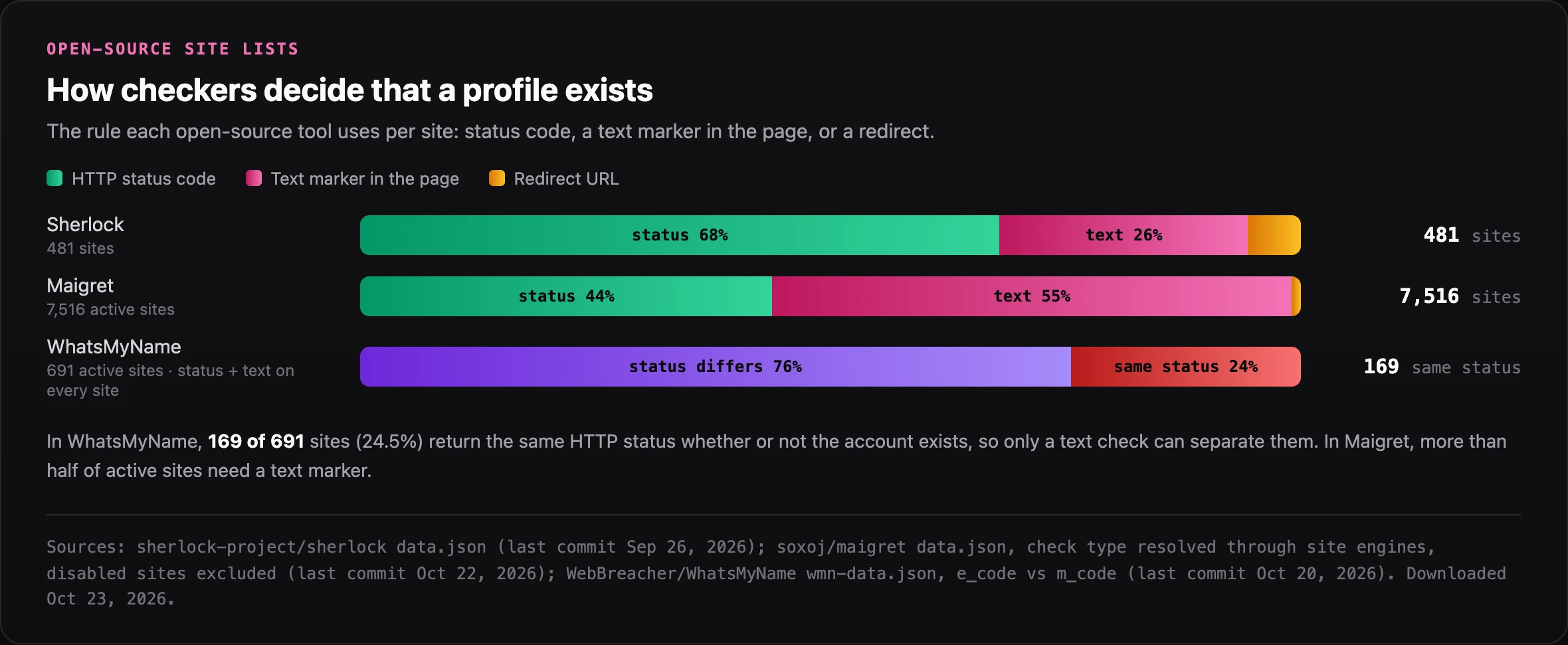
Sherlock leans on HTTP status codes for 68% of its sites — fast and simple, but only as reliable as each site’s willingness to return a distinct “not found” status. Maigret needs a text marker on 55% of its much larger list, because a bigger list inevitably includes more sites that return 200 OK for everything. WhatsMyName takes the strictest approach: it records both a status code and a text marker for every site in its dataset, which is precisely how it can tell you that 169 of its 691 sites (24.5%) cannot be separated by status code alone. That rigor is also why other tools, including Maigret, import WhatsMyName’s data rather than duplicating the work.
The Soft 404 Problem, Confirmed by Hand
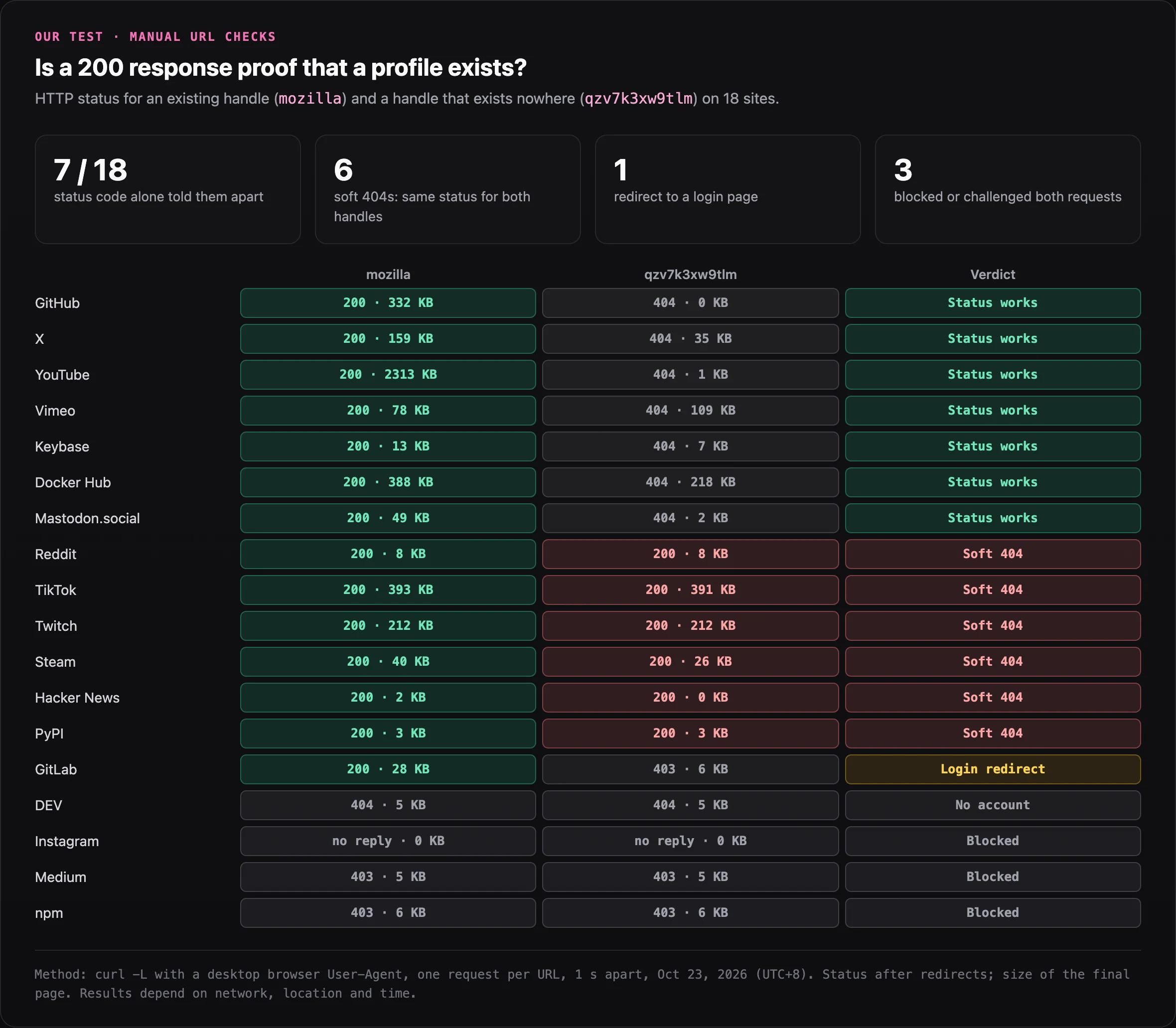
curl requests, October 23, 2026 — the same soft-404 behavior that forces WhatsMyName’s stricter rule and inflates Maigret’s text-marker share above.We requested 18 real profile URLs twice: once for mozilla, once for the random string qzv7k3xw9tlm. Status code alone told them apart on only 7 of 18. Six big names — Reddit, TikTok, Twitch, Steam, Hacker News, and PyPI — returned 200 OK for a handle that does not exist, a “soft 404”. This single manual test explains, concretely, why Chart 2’s percentages look the way they do: any tool that trusts status codes alone on these six sites will report false positives, no matter which project’s site list it uses.
Watching the Noise Floor on a Live Search
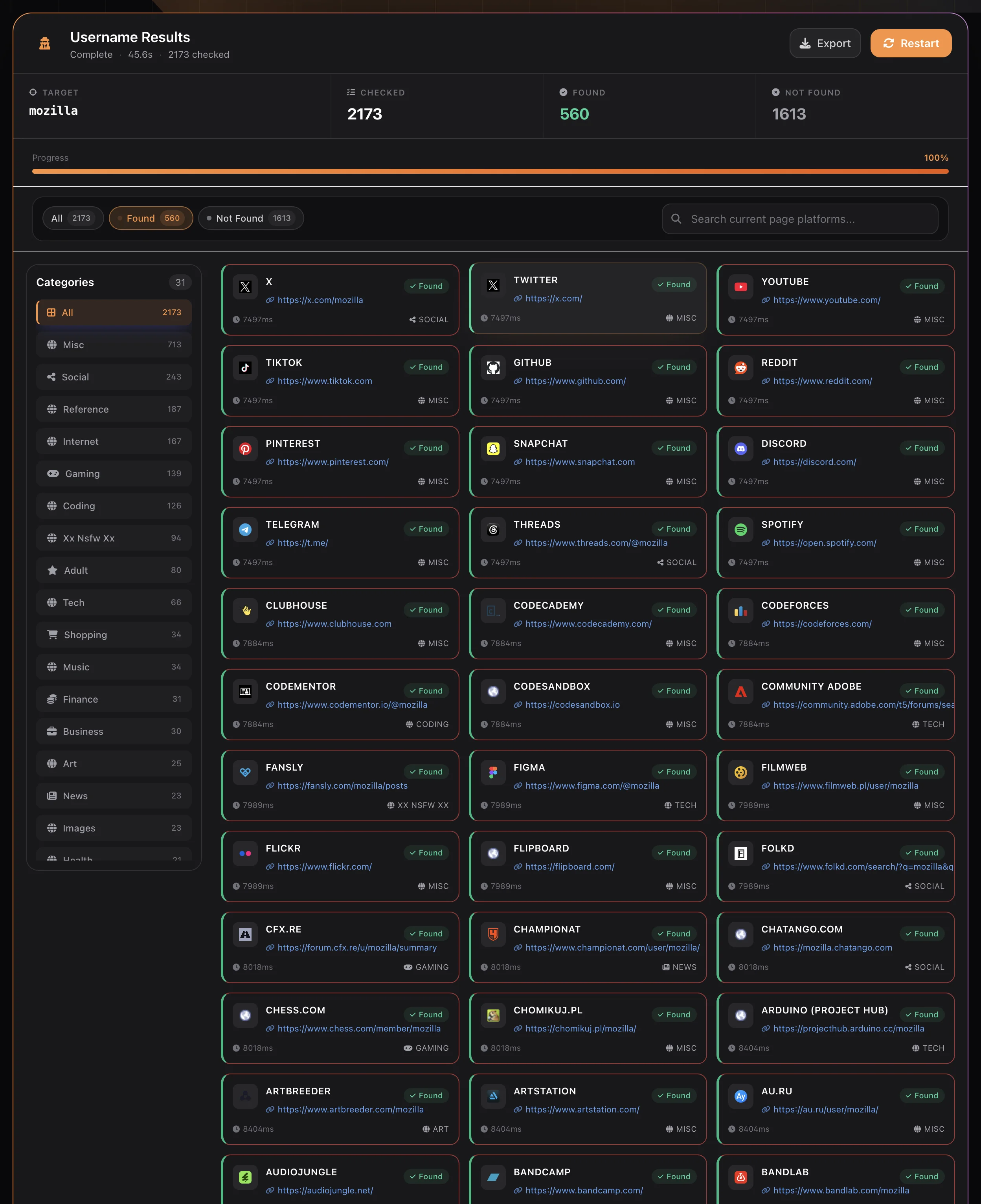
mozilla searched on Holehe OSINT, October 23, 2026: 560 of 2,173 sites reported “found” in 45.6 s.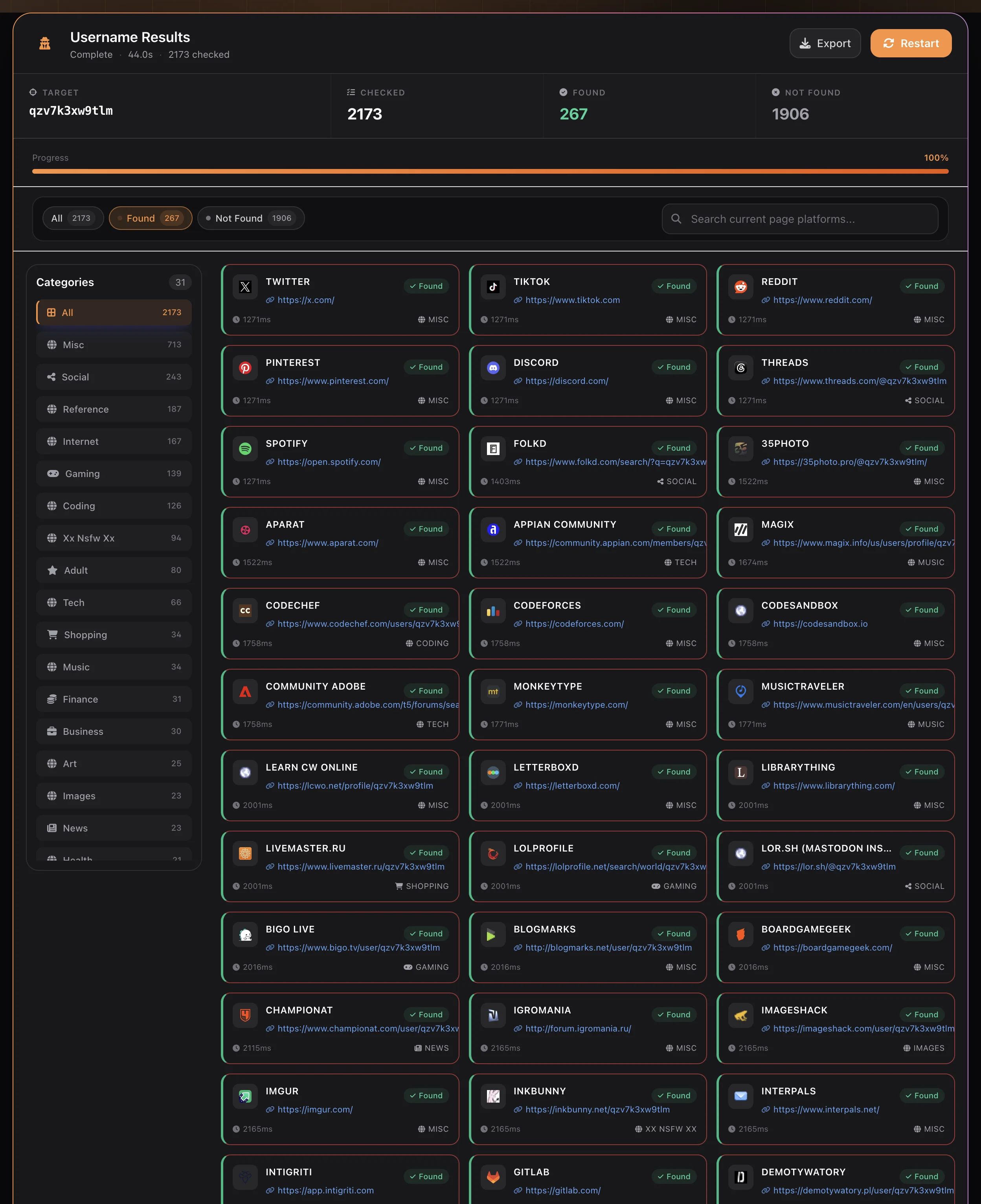
qzv7k3xw9tlm, searched a minute later: 267 sites still reported “found”, with no account possibly existing anywhere.This pair of searches is the single most useful test you can run on any username tool, not just Holehe OSINT: search a handle you care about, then search a string nobody could own, and subtract the overlap. Of mozilla’s 560 results, 261 also appeared for the random string; the 299 that remained were the ones worth opening by hand. Sherlock, Maigret, and WhatsMyName inherit the same soft-404 behavior shown in Chart 3, so the same control-string technique applies to their output too — tool choice does not remove the need for it.
What Holehe’s Own Checks Look Like
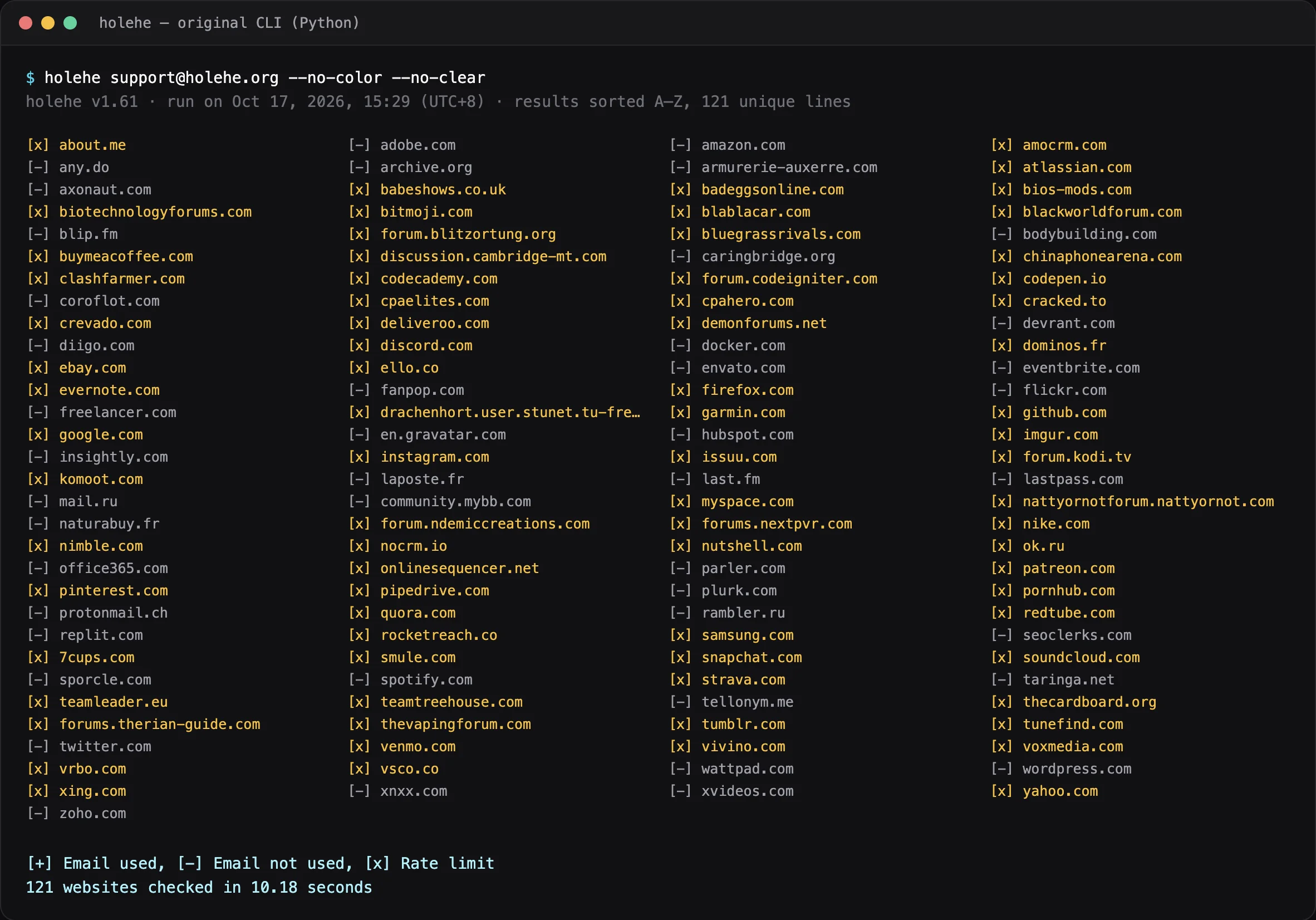
[email protected], October 17, 2026: 121 modules in 10.18 s, 0 used, 44 not used, 77 rate-limited.This is the project most people mean when they say “Holehe” in a list alongside Sherlock, Maigret, and WhatsMyName — and it is immediately obvious why a direct score-for-score comparison does not work: it checks email registration flows, not username profile URLs. Two findings stand out. First, 64% of modules (77 of 121) came back rate-limited on a single residential connection, well above the 31 the README itself flags as frequently rate-limited — automated email checking runs into the same kind of site-side defenses that trip up large-scale username checking. Second, the project’s most recent commit was September 10, 2024, with no commits in the 52 weeks before our October 9, 2026 check; it still runs, but nobody is actively repairing modules that sites change. Holehe OSINT’s hosted email search, run minutes later against the same address, completed without rate-limit gaps and found 22 of 111 services — not a cleaner signal, just a platform absorbing the rate limits instead of your own IP address.
Feature Comparison
| Feature | Holehe (CLI) | Sherlock | Maigret | WhatsMyName | Holehe OSINT |
|---|---|---|---|---|---|
| Identifier | Username | Username | Username | Email, username, phone, IP | |
| Installation | Python + pip, or Docker | Python + pip | Python + pip, or Docker | None (web) or clone the dataset | None — runs in a browser |
| Output | Terminal text, CSV | Terminal text, CSV/JSON | Terminal text, PDF/HTML report, JSON | Web results, raw JSON dataset | Real-time result cards, CSV export |
| Who absorbs rate limits | Your IP address | Your IP address | Your IP address | Depends on how you run it | The hosted platform |
| Extra profile parsing | No | No | Yes — can extract extra identifiers from found profiles | No (dataset only) | No |
| Best suited for | Scriptable email checks you control end to end | Fast, lightweight username sweeps | Deep username sweeps into forums and niche sites | A trustworthy dataset to build on, or quick spot checks | One search box for all four identifier types, no setup |
Decision Flowchart: Which One Fits Your Case?
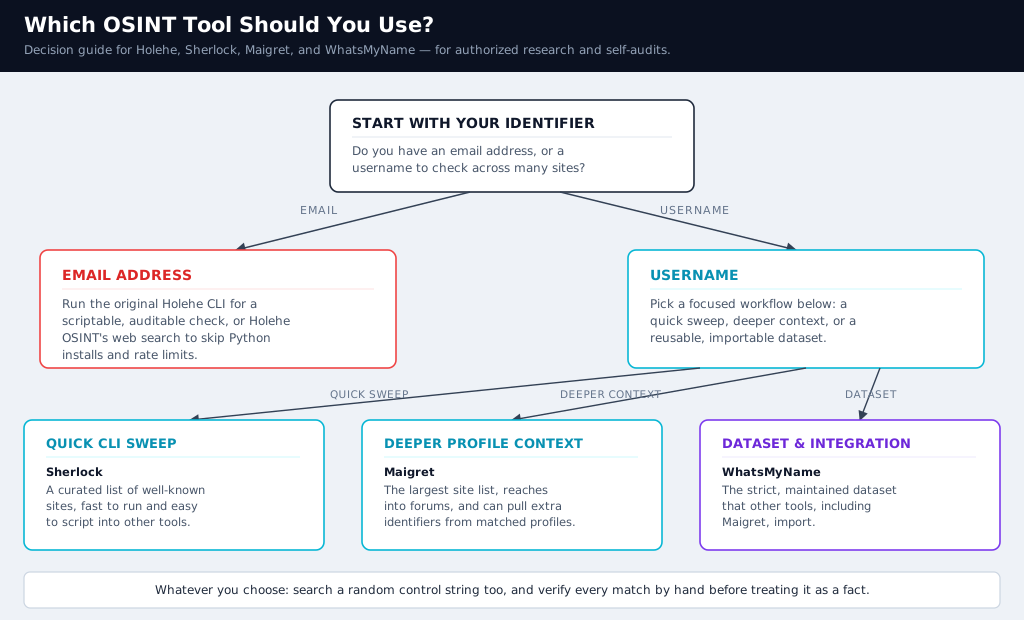
Which Tool Should You Reach For First?
- Starting from an email address: use the original Holehe CLI if you want a scriptable, auditable check inside your own environment, or Holehe OSINT if you want the same idea without installing Python or absorbing rate limits yourself.
- Need the widest possible username sweep and can tolerate forum noise: Maigret’s 7,516 active sites reach furthest into the “forgotten tail”, at the cost of more false positives and slower runs.
- Want a quick, lightweight username check on well-known platforms: Sherlock’s smaller, curated list runs fast and is easy to script into other tooling.
- Building your own checker, or want the dataset with the strictest per-site validation: WhatsMyName’s JSON file checks both a status code and a text marker on every entry, which is why Maigret and others import it.
- Starting from any one of email, username, phone, or IP and want one interface: Holehe OSINT is the only tool in this comparison that covers all four without a local install.
A Practical Workflow That Combines Them
- Start from what you have. An email address goes into Holehe (CLI or web); a username goes into Sherlock, Maigret, or Holehe OSINT’s username search.
- Run a control string alongside your real identifier, whichever username tool you use, and discard anything that also matches the control — Screenshots 1 and 2 above show why this step is not optional.
- Cross-check disagreements manually. If one tool reports a site as found and another does not, open the profile URL yourself; soft 404s (Chart 3) are common enough that neither tool is automatically right.
- Pivot between identifiers. An email’s local part is often a candidate username, and a username found on a developer platform can lead back to a public email address in a commit or profile field.
- Record tool, version, date, and result for anything you plan to rely on. Site definitions and registration flows both change; a result from six months ago is a lead, not a current fact.
Limitations Every One of These Tools Shares
- A “found” result is not proof of ownership. It means a service recognized the identifier, not who controls the account.
- Soft 404s produce false positives. Chart 3 shows six major platforms returning
200 OKfor a handle that does not exist; the same behavior affects email registration checks on sites that return identical responses either way. - Rate limiting produces false “not found” signals. 77 of 121 Holehe modules were rate-limited, not negative, in our test; treat “rate limit” or an error as unknown, never as a no.
- Bigger lists decay faster. A project with thousands of site definitions and infrequent updates accumulates more broken checks than a small, actively maintained one.
- None of them prove identity on their own. Corroborate with profile photos, bios, linked sites, and activity dates before treating two accounts as the same person.
Legal and Ethical Boundaries
- Observe, do not access. Checking whether an account exists is OSINT; logging in to it or guessing its password is unauthorized access under laws such as the US Computer Fraud and Abuse Act and the UK Computer Misuse Act.
- Personal data rules apply. Under the UK and EU GDPR, an email address or username tied to a person is personal data. Have a lawful basis — fraud prevention, brand protection, or auditing your own footprint — and keep only what that purpose needs.
- Respect platform terms. High-volume automated checks from a single IP address are exactly what the rate limits in our tests are designed to stop.
- Do not use results to harass, stalk, or take over accounts.
Frequently Asked Questions
Is Holehe the same kind of tool as Sherlock, Maigret, and WhatsMyName? No. The original Holehe checks email addresses; the other three check usernames. Holehe OSINT, the web platform, covers both plus phone and IP, which is the main reason to reach for it instead of picking a single-purpose CLI.
Which has the biggest site list? Maigret, with 7,516 active sites of 8,215 listed, more than ten times Sherlock’s 481.
Which is most accurate? None of them is uniformly most accurate — accuracy depends on the detection method, and Chart 3 shows that status-code-only checks miss soft 404s on major platforms regardless of which project’s list you run.
Do I need to install anything? Sherlock, Maigret, and the original Holehe CLI need a Python environment. WhatsMyName’s dataset can be queried without installing software of your own, though most people use it through another tool. Holehe OSINT needs only a browser.
Can I use more than one of these together? Yes, and the workflow above is built around doing exactly that — they answer overlapping but not identical questions.
Data Sources and Methodology
| Dataset | Used in | Source and method | Date | Sample |
|---|---|---|---|---|
| Username detection rules | Chart 2, feature table | Sherlock data.json, Maigret data.json, WhatsMyName wmn-data.json | Downloaded Oct 23, 2026 | 481 / 7,516 / 691 sites |
| Site coverage and tags | Chart 1 | Same data files; Holehe OSINT count from the search panel | Oct 23, 2026 | 4 lists; 8,215 Maigret sites listed |
| HTTP status spot check | Chart 3 | curl -L with a desktop browser User-Agent, one request per URL | Oct 23, 2026 | 18 sites × 2 handles |
| Holehe OSINT username searches | Screenshots 1–2 | Homepage username search, one connection, searches run minutes apart | Oct 23, 2026 | 3 handles, 2,173 sites each |
| Original Holehe CLI | Screenshot 3, email rows | holehe [email protected] --no-color --no-clear, version 1.61, clean Python environment | Oct 17, 2026 | 121 modules, 1 address |
| Holehe repository facts | Key findings, tool table | megadose/holehe GitHub repository and README | Oct 9, 2026 | 1 repository |
This comparison reuses two test sessions documented elsewhere on this site rather than running a new synchronized benchmark across all four tools on one day; dates above show exactly which figure came from which session. Limits apply accordingly: one connection, English-language platforms weighted toward the test handles chosen, and site lists that change on their own schedule — Sherlock, Maigret, and WhatsMyName each shipped commits within days of each other around this data pull. Figures for Sherlock, Maigret, and WhatsMyName describe their public data files, not a live run of each project’s CLI against the same handle on the same day.
References
- megadose/holehe — original Holehe repository and README
- sherlock-project/sherlock (last repository commit Sept 26, 2026)
- soxoj/maigret (last repository commit Oct 22, 2026)
- WebBreacher/WhatsMyName (last repository commit Oct 20, 2026)
- This site’s username OSINT test and original Holehe CLI test, which this article’s figures are drawn from
- ICO: Legitimate interests
Related Articles
Brand Protection
How to Spot Brand Impersonation Online: An OSINT Checklist Backed by FTC and APWG Data
OSINT Guide
OSINT vs SOCMINT vs HUMINT vs GEOINT: Which Discipline Does Each Holehe OSINT Search Belong To?

Username OSINT
Mapping a Username Footprint Across Thousands of Sites: A Practical OSINT Workflow