
Top OSINT Techniques for Digital Footprint Investigation
Explore OSINT techniques for finding online digital footprints using email, username, phone number, and IP intelligence.
A digital footprint is the trail of information a person or organization leaves online. Part of it is created on purpose (profiles, posts, a company website), and part of it is passive (data broker listings, leaked databases, DNS records, metadata in shared files). Investigating a footprint, whether your own or one you are authorized to research, rarely means finding one perfect source. It means taking one identifier, using what it reveals as the input for the next search, and keeping track of how strong each link really is.
This guide covers the techniques that make that process work: which disciplines each identifier belongs to, how to pivot from one identifier to the next, how to rate every hop, and how to catch the false links that end up in careless reports. A worked example with real Holehe OSINT results shows each step.
- A footprint investigation is a chain of pivots. Each result contains new identifiers (a domain, a handle, an IP address) that become the next search.
- Rate the link, not just the identifier. Email to its own domain is near-certain; a matching username on another site is often weak. A chain is only as strong as its weakest hop.
- Most false links have a short list of causes: common handles, search pages counted as profiles, shared hosting and CDNs, recycled phone numbers, and the same service appearing under several domains.
- Label where each finding came from (open web, social media, registries, imagery) so reviewers can see what kind of evidence it is.
How this guide was written. The worked example uses identifiers that belong to Holehe OSINT itself: the address[email protected], the domainholehe.org, the IP address it resolved to, and the handleholehe. Screenshots were captured from the Holehe OSINT homepage on October 17, 2026; DNS answers were checked the same day. No personal identifiers belonging to third parties were searched.
What Is a Digital Footprint Investigation?
At its core, a footprint investigation is record linkage: deciding whether records in different places refer to the same person or organization. Statisticians have studied this for decades, and one lesson carries straight over to OSINT:
- Deterministic matches on unique keys (a full email address, a domain, a registry handle) are strong.
- Probabilistic matches on non-unique fields (a name, a username, an avatar, a city) are only as good as the number of independent fields that agree.
So the unit of work is not the identifier. It is the link between two identifiers, and each link needs its own confidence rating.
Digital Footprint Sources and Their Intelligence Disciplines
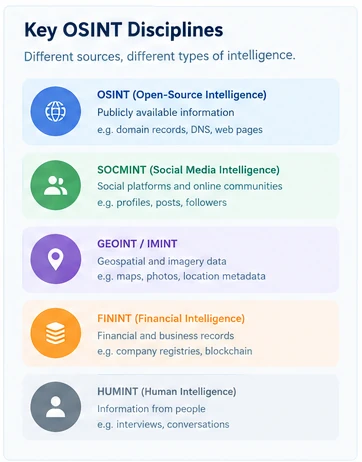
Open-source research borrows labels from the intelligence world. They are worth knowing, because they describe what kind of evidence a finding is, and that affects how much weight it can carry and what authorization the work needs:
- OSINT (Open-Source Intelligence): the umbrella for anything collected lawfully from openly available sources. Technical research on domains, DNS, and IP addresses is OSINT applied to infrastructure data.
- SOCMINT (Social Media Intelligence): the part of OSINT that works with social platforms: profiles, posts, follower networks, and usernames.
- GEOINT / IMINT (Geospatial and Imagery Intelligence): working out where and when a photo or video was taken, or what a place looks like, from maps and imagery.
- FININT (Financial Intelligence): company registers, sanctions lists, and public blockchain ledgers.
- HUMINT (Human Intelligence): information gathered from people through conversation or interviews. It is not open-source work, and a footprint investigation that reaches that point should stop and hand off.
In practice, research starts with an identifier, not a discipline. This table maps common starting points (all placeholders) to where they sit and where they usually lead:
| Identifier | Example | Main discipline | Holehe OSINT tab | Typical next pivots |
|---|---|---|---|---|
| Email address | [email protected] | OSINT | Registered services, its domain, a username in the local part | |
| Username | example_handle | SOCMINT | Username | Profiles, bio links, avatars, linked websites |
| Phone number | +1 202 555 0143 | OSINT | Phone | Country and number type, registered services, business listings |
| Domain | example.com | OSINT (technical) | IP, after a DNS lookup | Registration data, certificates, hosting, mail servers |
| IP address | 203.0.113.10 | OSINT (technical) | IP | Network owner, ASN, reverse DNS, abuse contact |
| Profile photo | An avatar image | IMINT / GEOINT | None; use reverse image search | Other accounts using the same image, location clues |
Few identifiers sit in one discipline alone. A username is SOCMINT, but the handle often came from an email address. That is why good reports record the provenance of each finding, not just its topic. For identifier-specific techniques, see the guides on finding websites by email address, username OSINT search, reverse phone lookup, and IP address OSINT.
OSINT Pivoting: Following One Identifier to the Next
A pivot is a hop from one identifier to another through a shared attribute. An email address contains a domain; the domain resolves to IP addresses; the local part of the address suggests a username; the username leads to profiles. Each arrow is a pivot, and each has a different strength. In practice, every investigation repeats the same four-step loop:
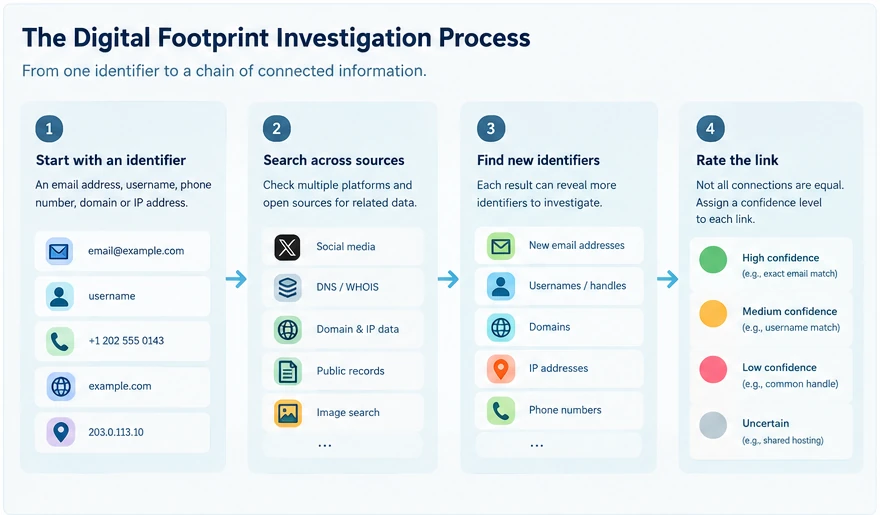
The rule that makes this useful: a chain’s confidence is the confidence of its weakest link. If you reach a profile through a low-confidence username hop, everything you find from that profile is low confidence too, however solid the later hops look.
Worked Example: Pivoting From an Email Address
The starting point is the site’s own support address. Each step below records the observation, what it does and does not support, and whether the chain should continue.
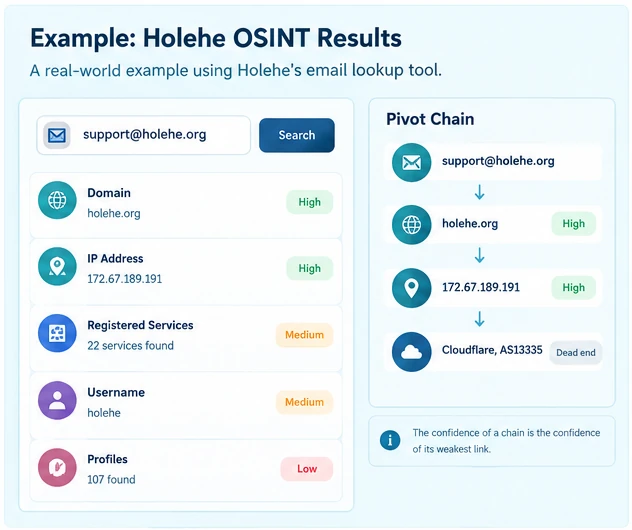
Step 1 — Email search: what services recognize the address?
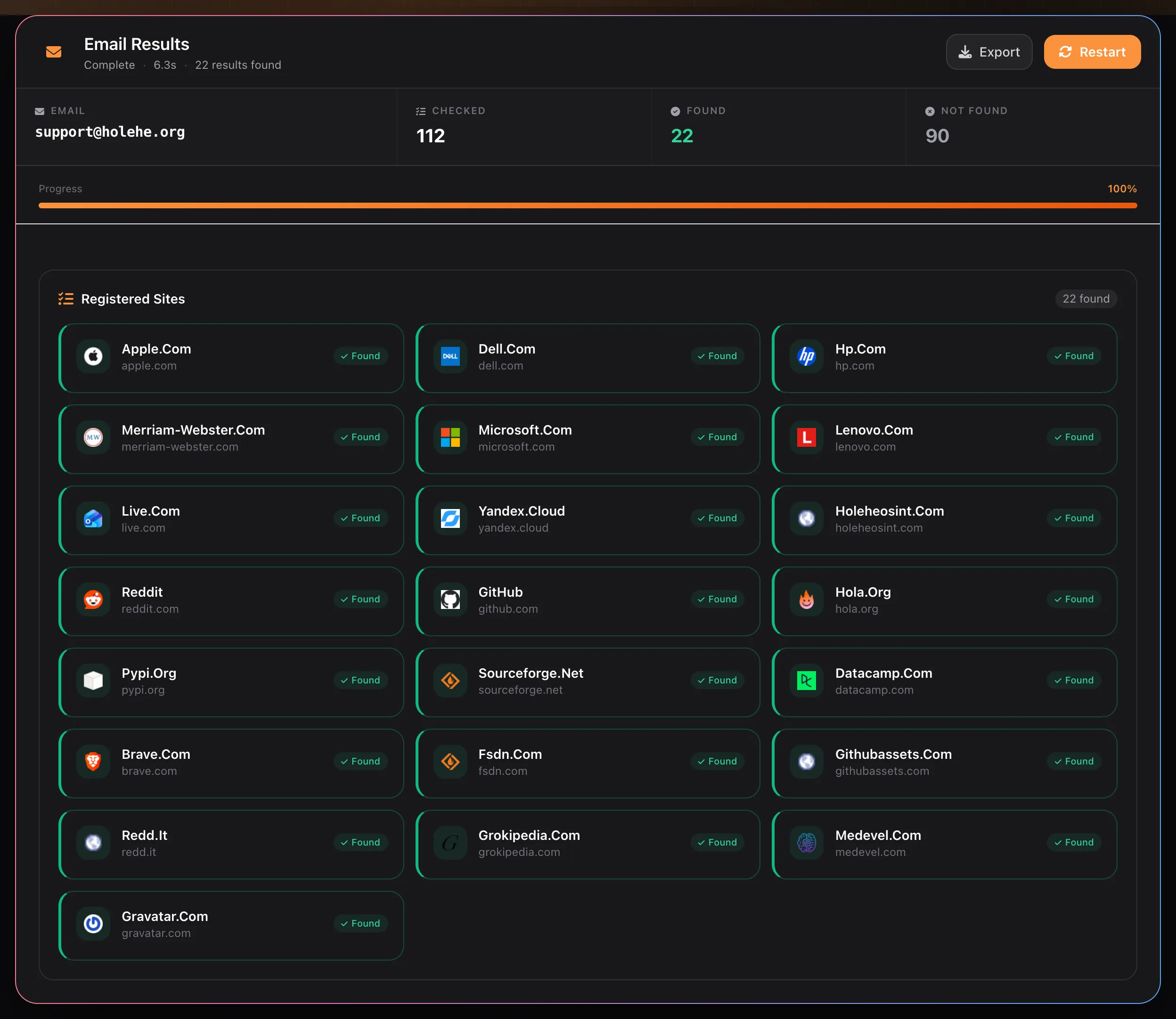
[email protected]. 112 services checked, 22 found, 90 not found, completed in 6.3 s on October 17, 2026.Observation. Twenty-two services treated the address as known. Several are one company under two domains: microsoft.com and live.com, reddit.com and redd.it, github.com and githubassets.com, sourceforge.net and fsdn.com. Counted once per company, that is 18 services, not 22.
A time check. The same search on October 11, 2026 returned 18 found. Six days later, Apple, Dell, HP, Lenovo, Merriam-Webster, and Grokipedia had appeared, and Apify and Medium were gone. Nothing about the address had changed. What changes is how each service responds to checks, so a result that disappears is not evidence that an account was deleted, and a new one is not evidence it was just created.
Confidence: medium. A registration signal says a service recognizes the address. It does not say who registered it, when, or whether the account is still in use.
Step 2 — Domain and DNS: where does the address point?
The domain is the strongest pivot an email address offers, because it is part of the identifier itself. A plain DNS lookup is enough:
dig +short holehe.org A returned 172.67.189.191 and 104.21.49.106; dig +short holehe.org NS returned mark.ns.cloudflare.com and riya.ns.cloudflare.com.
Confidence: high for “this domain currently resolves to these addresses”. Record the date: DNS answers change, and anyone repeating the lookup later may see different values.
Step 3 — IP search: who operates that address?
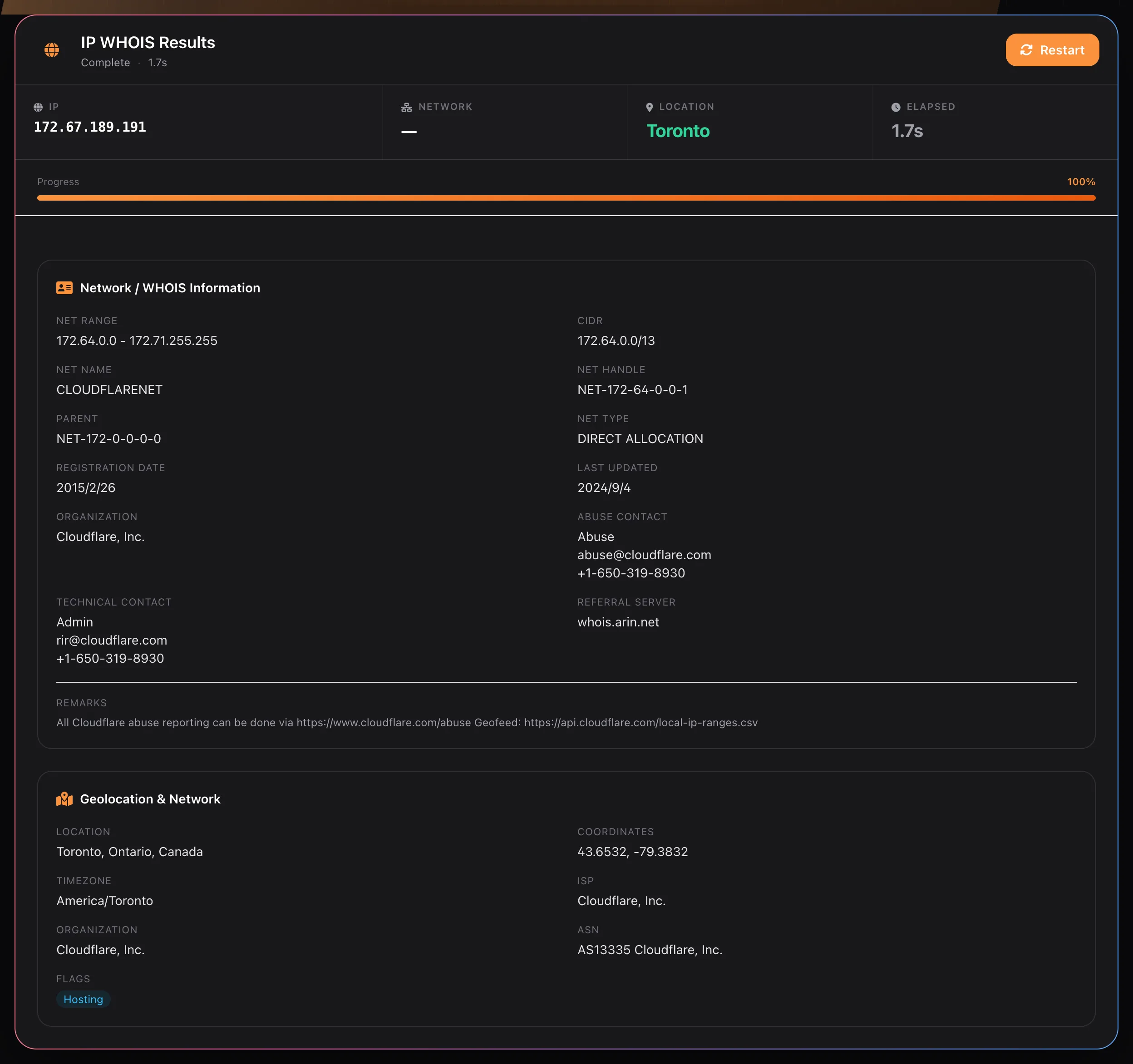
172.67.189.191. WHOIS: 172.64.0.0/13 (CLOUDFLARENET), Cloudflare, Inc., registered through ARIN. Geolocation: Toronto, Ontario, Canada, AS13335, flagged Hosting. Completed in 1.7 s.Observation. The address belongs to Cloudflare’s 172.64.0.0/13 block, which alone holds 524,288 addresses, and the name servers are Cloudflare’s too. The site sits behind a CDN and reverse proxy.
Interpretation. This is a textbook dead end. Thousands of unrelated websites share Cloudflare addresses, so searching for “other sites on this IP” would connect holehe.org to strangers. The Toronto location describes the address range in a geolocation database, not where the site’s operator or origin server is. Confidence: high that the IP is Cloudflare; no value as a pivot to anything else. The chain stops here.
Step 4 — Username search: where does the brand handle appear?
The domain name suggests a handle, holehe. That is a probabilistic pivot: the string matches, but nothing yet says the same operator is behind it.
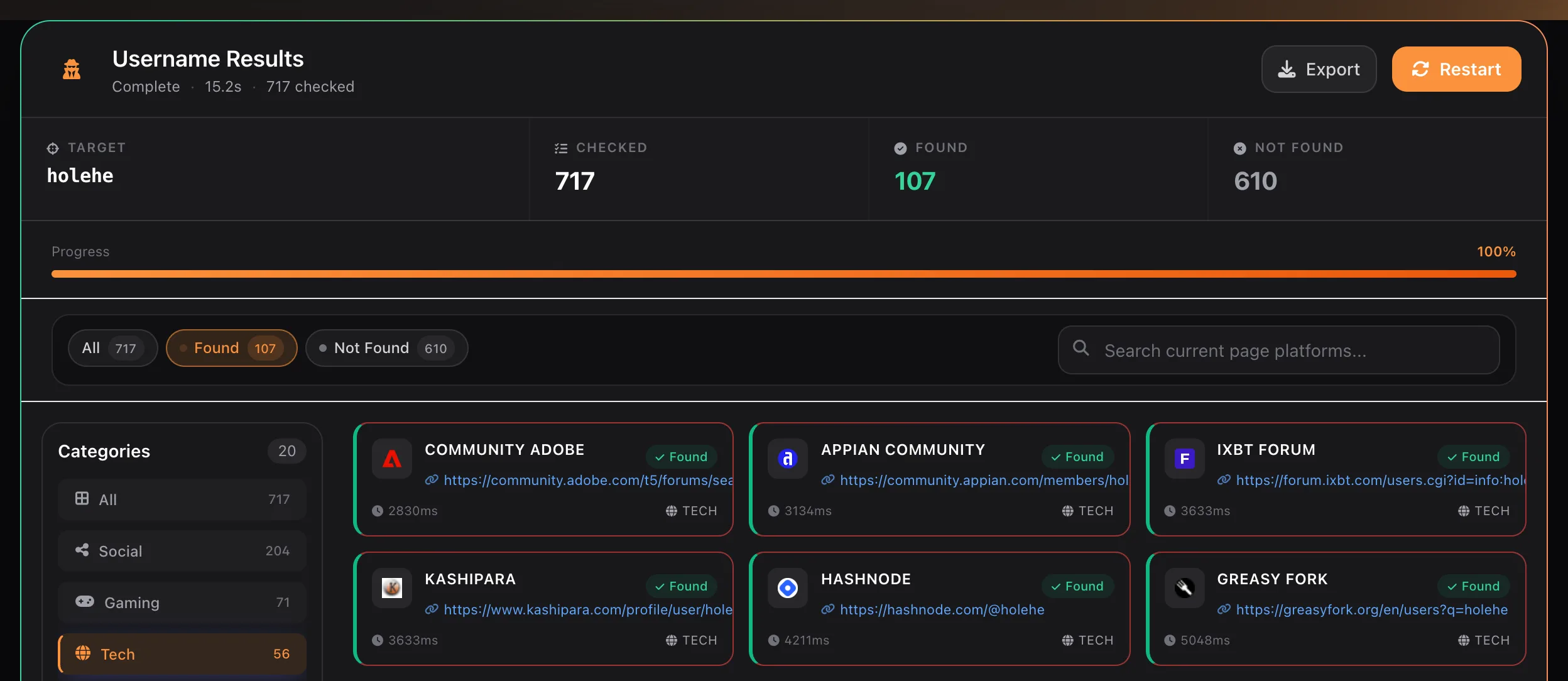
holehe, filtered to Found → Tech. 717 sites checked, 107 found, 610 not found, completed in 15.2 s.Observation. 107 “Found” results is not 107 accounts. Look at the full URLs behind the Tech cards:
community.adobe.com/t5/forums/searchpage/tab/user?q=holehe,greasyfork.org/en/users?q=holehe, andcommunity.evocms.ru/users/?search=holeheare search result pages, not profiles. The check found a page that responded; it did not find an account.- In a run of the same search a few minutes earlier, the Found list across all categories included ten results on adult-content sites, which says a lot about how many unrelated people use a short, pronounceable string as a handle.
- None of the results is the open-source Holehe project’s official home, which is
github.com/megadose/holehe.
Confidence: low for every card until a second, independent attribute agrees: a bio that links back to holehe.org, the same logo, or a matching creation date.
What the chain produced
| Hop | Method | Result | Confidence | Reason |
|---|---|---|---|---|
| Email → services | Email search | 22 cards, 18 distinct services | Medium | Registration signal only; results vary by date |
| Email → domain | Part of the identifier | holehe.org | High | Deterministic |
| Domain → IP | DNS A record | Two Cloudflare addresses | High | Direct lookup, dated |
| IP → anything else | IP search | Cloudflare, AS13335 | None | Shared CDN infrastructure |
| Domain → handle → profiles | Username search | 107 cards | Low | String match; includes search pages and obvious collisions |
Two of five pivots produced something reliable, one was a dead end, and the busiest result (107 cards) was the weakest. That is a normal outcome, and the report should say so.
A Confidence-Rated Pivot Table
Use this as a starting point for rating each hop, then adjust it for your sources:
| From → To | Typical method | Default confidence | Upgrade when | Downgrade when |
|---|---|---|---|---|
| Email → domain | Read the address | High | The domain is not a free mail provider | Free webmail (the domain says nothing about the user) |
| Domain → IP | DNS lookup | High | Dedicated server | CDN, shared hosting |
| Email → registered service | Email search | Medium | Masked recovery hints match other findings | Service known to give inconsistent responses |
| Username → profile | Username search | Low | Bio link, same avatar, or matching dates agree | Common handle, search-page URL, no profile details |
| Phone → person | Phone search, listings | Low to medium | Recent, consistent listings | Old listings; numbers get reassigned |
| IP → organization | WHOIS / RDAP | High for the network | Small, dedicated allocation | Large ISP, mobile carrier, CDN, VPN |
| Photo → other accounts | Reverse image search | Medium | Original upload found | Stock or widely shared image |
How False Links Get In, and How to Test for Them
- Common handles. Short or wordy handles exist on hundreds of sites, owned by different people. Test: require two independent attributes to agree before treating two accounts as one operator.
- Search pages counted as profiles. Some site checks hit a search URL that always responds. Test: open the link; if the URL contains
?q=or?search=and shows a results list, it is not an account. - Shared infrastructure. CDNs and cheap hosting put thousands of unrelated sites on the same IP addresses. Test: check the WHOIS organization before pivoting from an IP; a CDN or large host ends the chain.
- One service, many domains. Services check registration on more than one domain, which inflates counts. Test: group results by company before counting.
- Recycled phone numbers. Numbers are reassigned after disconnection; in the US, the FCC runs a reassigned numbers database for exactly this reason. Test: weight recent listings above old ones.
- Privacy-protected registrations. Two domains with the same redacted registrant or privacy service are not linked by that fact. Test: ignore shared privacy details; look for shared unique values instead.
- Namesakes. A name search returns everyone with that name. Test: pivot on distinguishing attributes, not the name alone.
Top OSINT Techniques for Digital Footprint Research
1. Advanced search operators
Operators make search engines precise: quotes for exact phrases, site: to limit results to one domain, filetype: to find documents, and intitle: to match page titles. For example, "jane doe" site:linkedin.com or "example.com" filetype:pdf. Run each new identifier from a pivot through a few of these before moving on.
2. Web archives
The Internet Archive’s Wayback Machine stores past versions of web pages. Deleted bios, old team pages, and earlier contact details often survive there, along with capture dates, which makes archives the natural tool for checking whether a link existed at a particular time.
3. Reverse image search (IMINT)
Profile photos and logos are frequently reused. Google Lens, Bing Visual Search, TinEye, and Yandex can find other places an image appears, which helps confirm that two accounts share an operator, or expose stolen photos used by fake profiles. A matching avatar is one of the best ways to upgrade a low-confidence username pivot.
4. File metadata
Documents and photos can contain author names, software versions, creation dates, and for photos sometimes GPS coordinates. Many large social platforms strip photo metadata on upload, but files shared directly, on personal sites, or as document attachments often keep it.
5. Domain, DNS, and certificate records
Registration data (RDAP/WHOIS), DNS records, and certificate transparency logs (searchable at crt.sh) can reveal related domains, subdomains, and mail providers. As the worked example shows, check whether a domain sits behind a CDN before reading anything into its IP addresses.
6. Timeline analysis
Creation dates are underused. A domain, a social account, and a forum profile all created in the same week form a pattern even when no shared string connects them. Build a simple timeline of first-seen dates for every identifier and look for clusters.
Building a Digital Footprint Report
Recommended Investigation Order
- Define the scope: whose footprint, why, what you are authorized to collect, and your pivot budget, the number of hops from the starting identifier that are in scope. Three is usually enough.
- Run the primary identifier (email, username, phone, or IP) through Holehe OSINT and record the date, the counts, and whether the run reached 100%.
- Open every result you plan to use. Drop search pages, placeholders, and dead links.
- Extract secondary identifiers from profiles and records, and write down which finding each one came from.
- Rate each hop with the pivot table before using it as the base for the next search.
- Reverse the chain to test it. Start from your conclusion and pivot backwards. If it does not lead back to the starting identifier by an independent route, the forward chain may rest on a coincidence.
- Write the report so confirmed facts, leads, and dead ends are clearly separated.
Report columns that keep findings defensible
| Finding | Source and time | Discipline | Pivoted from | Confidence and reason |
|---|---|---|---|---|
| Domain resolves to Cloudflare | DNS lookup, Oct 17, 2026 | OSINT (technical) | holehe.org | High; direct lookup. Dead end for further pivots |
Profile named holehe on a developer site | Username search, Oct 17, 2026 | SOCMINT | Handle from domain | Low; no corroborating attribute yet |
The discipline column takes seconds to fill in, and it answers the first question a reviewer usually asks: was this from an open source, a social platform, a registry, or a person?
Rate your confidence
| Level | Meaning | Example |
|---|---|---|
| Confirmed | Two or more independent sources agree | A profile links to a website that lists the same email |
| Probable | One strong signal, nothing contradicting it | The same rare username and photo on two sites |
| Possible | Weak or single signal | A common username match with no other overlap |
Know when to stop
If the next step would mean contacting people, joining closed groups, using someone else’s credentials, or obtaining non-public records, the work has left open-source research. Stop, and escalate to whoever can authorize that kind of work.
Reducing Your Own Digital Footprint
The same pivots work defensively. Every link an investigator can follow is a link you can break:
- Break the email pivot: use separate addresses or aliases for sign-ups, so one address does not connect everything.
- Break the username pivot: avoid reusing one distinctive handle for both professional and personal accounts.
- Break the image pivot: use different profile photos on unrelated accounts.
- Close forgotten accounts: run your own email through Holehe OSINT, then delete or lock down services you no longer use.
- Remove direct identifiers: take phone numbers and birth dates off public profiles.
- Check breach notification services and change any reused passwords.
- Ask data broker sites to remove your listing, where local law gives you that right.
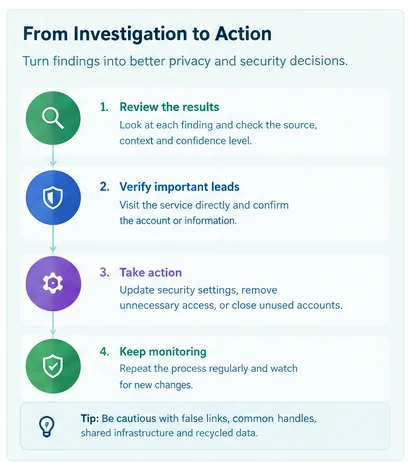
Then turn the audit into a routine rather than a one-off:
Legal and Ethical Limits
Open-source does not mean unregulated. Personal data can fall under privacy law (for example the GDPR in the EU and UK) even when it is publicly visible, and platform terms still apply. Keep a written purpose, collect only what that purpose needs, respect your pivot budget, and never use findings for stalking, harassment, or account takeover.
Frequently Asked Questions
What is OSINT pivoting? Taking an attribute from one search result, such as a domain, a username, or an IP address, and using it as the input for the next search, while rating the strength of each hop.
How many pivots should an investigation use? Decide before you start. Three hops from the original identifier is usually enough; every extra hop increases the chance of a false link and pulls in data about people unrelated to your question.
Is SOCMINT the same as OSINT? SOCMINT is the part of OSINT that deals with social media. It follows the same rules, but social data is personal by nature, so it needs extra care with scope and retention.
Does a “Found” result prove someone owns an account? No. It shows a service or page responded to the identifier. Ownership needs corroboration from an independent attribute.
Why do results change between runs? Services change how they respond, some checks hit rate limits, and coverage lists are updated. Record the date and counts with every result, as the email example above shows.
Why a Unified OSINT Platform Saves Time
Manually checking dozens of websites for every pivot is slow and error-prone. A unified platform like Holehe OSINT automates the repetitive checks across email, username, phone, and IP searches, so investigators can spend their time on what tools cannot do: rating links, testing for false matches, and drawing careful conclusions.
References
- Record linkage (deterministic and probabilistic matching)
- Berkeley Protocol on Digital Open Source Investigations (OHCHR and UC Berkeley Human Rights Center)
- Cloudflare IP ranges (published address blocks, including 172.64.0.0/13)
- RFC 9083: RDAP JSON responses (registry fields for IP networks and domains)
- FCC Reassigned Numbers Database (why old phone links decay)
Related Articles
Brand Protection
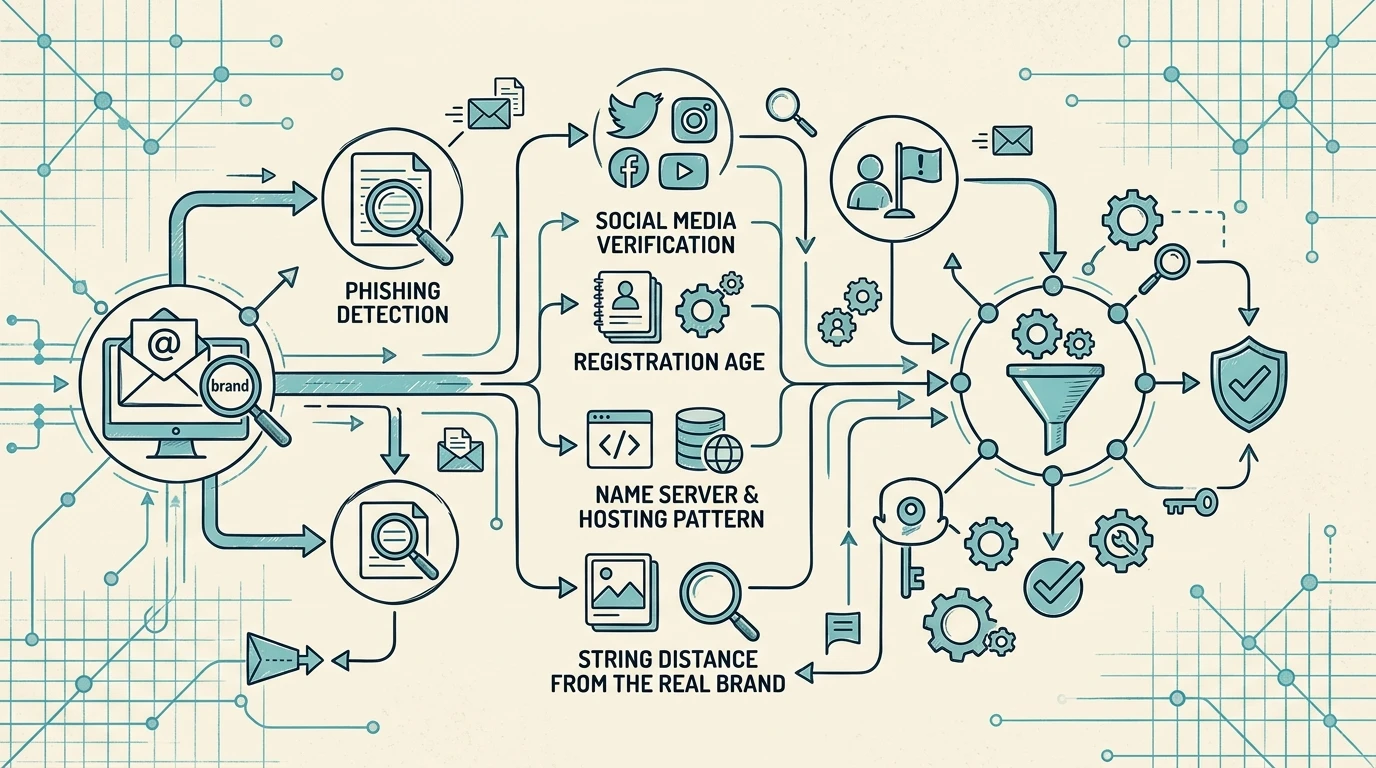
How to Spot Brand Impersonation Online: An OSINT Checklist Backed by FTC and APWG Data
OSINT Guide
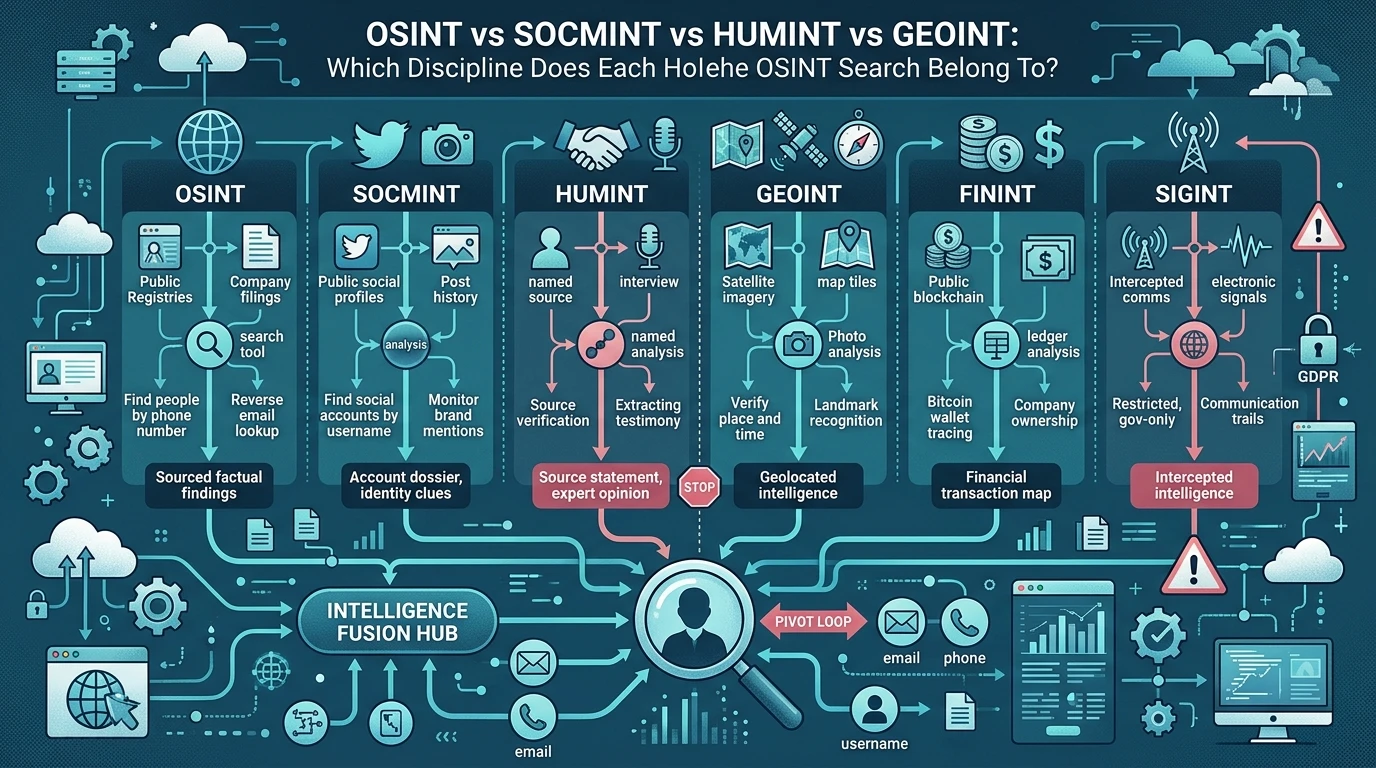
OSINT vs SOCMINT vs HUMINT vs GEOINT: Which Discipline Does Each Holehe OSINT Search Belong To?

Username OSINT
Mapping a Username Footprint Across Thousands of Sites: A Practical OSINT Workflow